Thailand receives around forty million visitors a year, and they concentrate in Bangkok, Chiang Mai, Phuket, Samui, Krabi and Pattaya. The rest of the country — which is most of it — sees very few, and is correspondingly cheaper and more relaxed.
Isaan, the northeast
A third of Thailand by area and by population, bordering Laos and Cambodia, and almost entirely absent from foreign itineraries.
What is there: the Khmer temples at Phanom Rung and Phimai, contemporaneous with Angkor and nearly empty. The Mekong river towns — Nong Khai, Chiang Khan, Nakhon Phanom — looking across at Laos. And the best food in Thailand, which is a defensible claim: som tam, larb, grilled chicken and sticky rice all originate here.
English is limited. Infrastructure is basic. Prices are local. Those three facts are related.
Access: overnight train or bus from Bangkok, or fly to Udon Thani, Khon Kaen or Ubon Ratchathani.
Nan province
Tucked against the Laos border in the far north, in a valley ringed by mountains. Wat Phumin's murals are among the finest in Thailand, the old town is walkable, and the road over the mountains from Nan to Pua is a genuinely good drive.
It sees a trickle of Thai weekenders and very few foreigners.
The Trang and Satun islands
South of Krabi, and a completely different scale of development.
Koh Mook has the Emerald Cave, reached by swimming through a dark tunnel into a hidden beach inside the island. Koh Kradan is a long strip of sand with a handful of resorts. Koh Ngai is smaller again.
No nightlife to speak of, limited electricity hours on some islands, and boats that run on the weather rather than a timetable.
Sukhothai and Si Satchanalai
The first Thai kingdom's capital, with a historical park of ruined temples and lotus ponds that is quieter and more atmospheric than Ayutthaya. Si Satchanalai nearby is emptier still.
Rent a bicycle and spend a day. It is one of the most rewarding half-days in Thailand and gets a fraction of Ayutthaya's traffic.
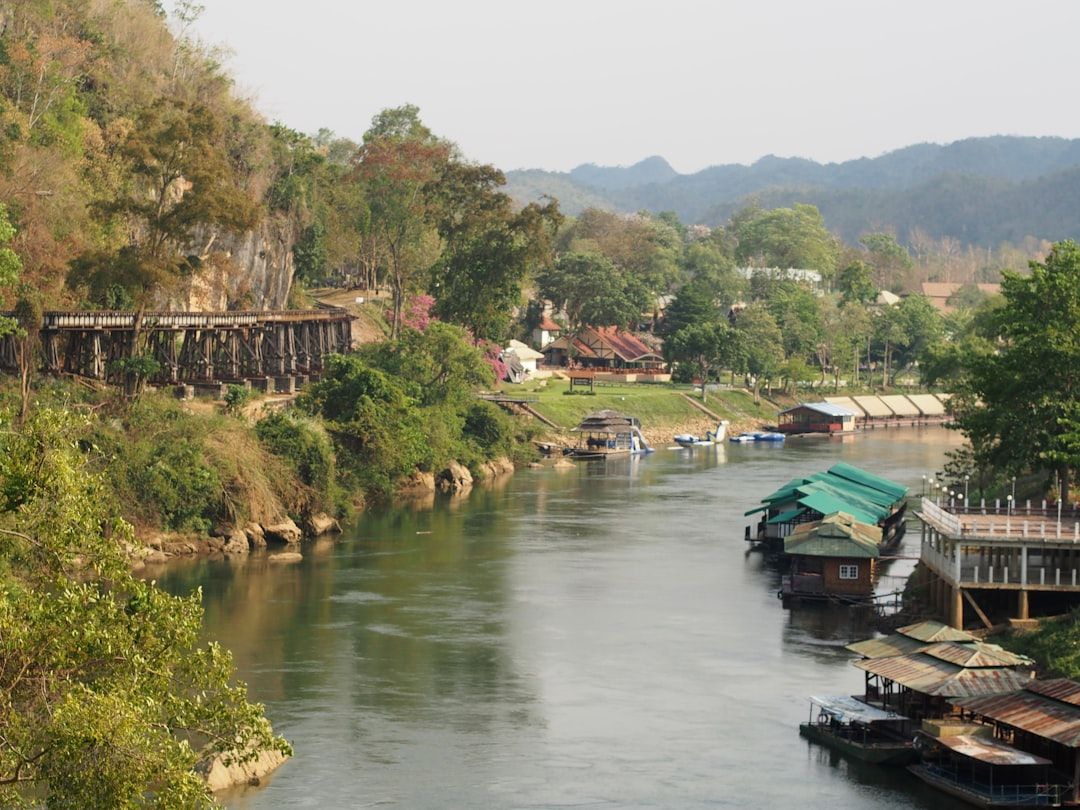
Kanchanaburi and the west
Beyond the bridge on the River Kwai and the war cemeteries, which are visited, the province extends into Erawan and Sai Yok national parks and up to the Burmese border at Sangkhlaburi, where a long wooden bridge crosses a reservoir and the Mon community lives.
Practical
| Item | Quiet provinces | Tourist centres |
|---|---|---|
| Guesthouse room | 250–500 THB | 800–2,500 |
| Local meal | 40–70 | 120–300 |
| Scooter per day | 150–250 | 250–400 |
Less English. A translation app and learning Thai numbers make a real difference. Thai people are notably patient with attempts.
Transport is slower. Songthaews rather than minibuses, and departures when full rather than on schedule.
Dress and conduct matter more in provincial temples and villages than in the tourist centres, where standards have relaxed. Shoulders and knees covered, shoes off, no photographs of people without asking.
When to go
November to February throughout. Avoid March and April in the north and Isaan, when agricultural burning makes the air genuinely unhealthy and the heat is severe. The Trang islands follow the Andaman season and are best November to April.